Zodiacal light
A faint glow of sunlight scattered by interplanetary dust.

Zodiacal light, also called false dawn when seen before sunrise, is a faint glow of diffuse sunlight scattered by interplanetary dust. It appears as a roughly triangular shape along the zodiac and contributes to the natural light of a clear, moonless night sky.
- type
- Astronomical phenomenon
- also_called
- False dawn
- caused_by
- Sunlight scattered by interplanetary dust
- related_phenomenon
- Gegenschein (counterglow)
Lore & Background
The zodiacal light is produced by sunlight reflecting off dust particles in the Solar System known as cosmic dust. Its spectrum is the same as the solar spectrum. The material producing the light is located in a lens-shaped volume of space centered on the Sun and extending well out beyond Earth's orbit. This material is known as the interplanetary dust cloud. Since most of the material is located near the plane of the Solar System, the zodiacal light is seen along the ecliptic. The amount of material needed is quite small: if it were in the form of 1 mm particles with the Moon's albedo, each particle would be 8 km from its neighbors. The origin of the dust has been long debated. Over 85 percent of the dust is attributed to occasional fragmentations of Jupiter-family comets that are nearly dormant. The first fully dynamical model of the zodiacal cloud demonstrated that only if the dust was released in orbits that approach Jupiter is it stirred up enough to explain the cloud's thickness. The Poynting–Robertson effect forces the dust into more circular orbits while spiralling slowly into the Sun, so a continuous source of new particles is needed. Cometary dust and dust generated by collisions among asteroids are believed to be mostly responsible for maintaining the cloud.
Reader's Guide
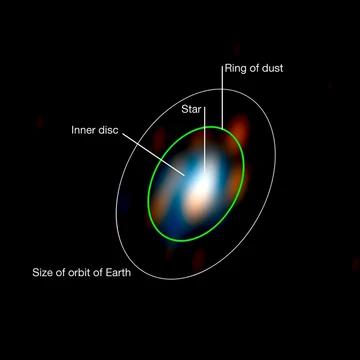
The phenomenon is best observed in mid-latitudes in the western sky in spring after evening twilight or in the eastern sky in autumn before morning twilight. It appears as a column brighter at the horizon, tilted at the angle of the ecliptic. The dust band causing it is uniform across the whole ecliptic. Spacecraft observations from Pioneer 10 and Helios in the 1970s revealed it is scattered by the interplanetary dust cloud. The phenomenon is also relevant to exoplanet research, as exozodiacal dust around nearby stars can be a potentially important source of noise in attempts to directly image extrasolar planets and may indicate the presence of planets.
Did You Know?
- The zodiacal light is also called false dawn when seen before sunrise.
- Over 85 percent of the zodiacal dust is attributed to fragmentations of Jupiter-family comets.
- The Islamic prophet Muhammad described zodiacal light as 'false dawn' to define prayer times.
Frequently Asked Questions
What is Zodiacal light?
Zodiacal light is a faint, diffuse glow visible in a clear, moonless night sky, shaped roughly like a triangle that stretches along the zodiac. It is produced when sunlight is scattered by tiny dust particles drifting between the planets.
What causes Zodiacal light?
It is caused by interplanetary dust particles reflecting and scattering sunlight toward the observer. The dust is spread throughout the inner solar system, and the glow is most visible when the Sun is below the horizon.
What is another name for Zodiacal light?
When the glow is observed just before sunrise, it is commonly referred to as "false dawn." A related effect called the Gegenschein, or counterglow, can also be seen under dark-sky conditions.
Why is Zodiacal light important to astronomy?
It reveals the presence and distribution of interplanetary dust, giving astronomers clues about the composition and dynamics of the inner solar system. It also contributes measurably to the natural background brightness of a dark night sky.
More in Astronomical Concepts And Techniques 1-22
Spotted an error? Know more?
This is a living reference — every entry is fact-audited, and reader corrections feed straight into our audit queue. Suggest an edit · See this site's audit record